|
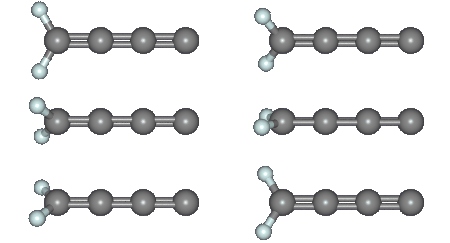
Butatrienylidene (H2C4) was discovered in 1991 in the
circumstellar shell of IRC + 10216 by
Cernicharo et al. using the
IRAM 30m radiotelescope using experimental spectra of the
species measured by Killian et al.
Subsequent detections include dense molecular cloud TMC-1 by
Kawaguchi et al. in 1991 and toward
the low-mass protostar IRAS 04368+2557 in L1527 by
Sakai et al. in 2008.
The H2Cn species are known as
cumulene
carbenes. For an even number of carbon atoms,
they are much less stable than their acetylenic counterparts, HCnH,
in the case of of butatrienylidene,
diacetylene. However, where the
acetylenic compounds have no permanent dipole moments, the cumulene carbons have very large dipole moments
and therefore have intense rotational spectra.
|