|
The discovery of the C4H (butadiynyl) radical toward IRC +10216 was reported in 1978 by
Guélin et al., based upon 4 observed doublet rotational
transitions that were predicted with molecular structure calculations. The species was subsequently detected in the
Taurus Molecular Cloud TMC-1 by
Irvine et al. in 1981 and by
Bell et al. in 1982. Both of these papers identified new spectroscopic
features of C4H. The rotation spectrum was measured in the lab by
Gottlieb et al. in 1983, confirming the earlier theoretical predictions.
The spectrum of C4D was measured by Woodward et al.
and then identified in TMC-1 in 1989 by Turner. The
C4H- anion was
identified in 2007.
The butadiynyl radical can be formed by removing one of the H atoms from
diacetylene (butadiyne). This suggests a ground
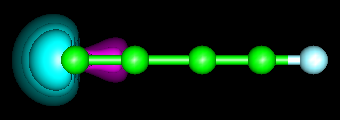
state (2Σ+) where the singly-occupied orbital is parallel to the molecular axis.
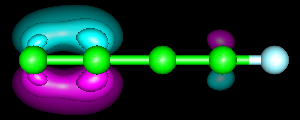
While this is indeed the most stable state, there is a 2Π state that lies only about
200 cm-1 higher in energy (as measured by
Zhou et al.). The singly occupied orbitals of each state are
shown below.
|
|
| 2Σ+
| 2Π
|
| 
|
|