|
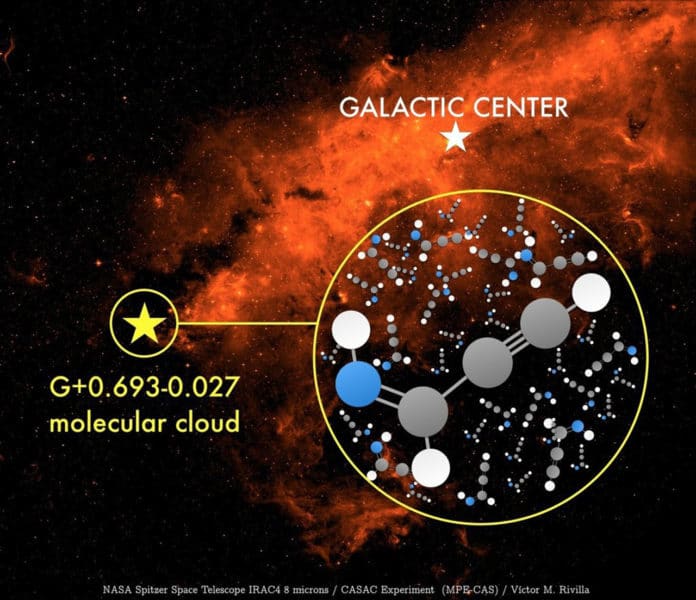
The trans rotamer of thioformic acid, t-HC(O)SH, was detected toward the galactic center source
G+0.693–0.027 by
Rodríguez-Almeida and co-workers,
as reported in 2021. The
IRAM 30m and the
Yebes 40m telescopes were employed to make
the observations, in which nine a-type transitions were detected. Trans-thioformic acid has also been
tentatively detected toward the massive protostellar core
G31.41+031 by
García de la Concepción and co-workers.
The cis form was not detected by either effort.
Wang and co-workers identified a possible
formation path to t-HC(O)SH on interstellar ice, while
Molpeceres and co-workers characterized
the destruction of formic and thioformic acid via H-abstraction reactions.
|
|
|
|
In addition to trans and cis rotamers—more properly anti and syn forms, since the rotation is around a
single bond instead of a double bond—thioformic acid has two isomeric forms that are close in energy. The
sulfur in the detected and most stable form of thioformic acid, HC(O)SH, is in the form an
–SH thiol, the sulfur version of the –OH hydroxyl
radical in alcohols. In the other form of thioformic acid, HC(S)OH, the sulfur is in the form of a
=S thione, the sulfur version of a =O ketone or aldehyde.
Lignell and co-workers characterized
the vibrational spectra of these compounds, as well as dithioformic acid, HC(S)SH. At least two other less stable
isomers are known,
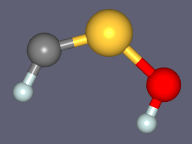
sulfine, H2CSO, and HCSOH, which is a carbene
stabilized by dative π bonding between the C and S atoms (not a C≡S triple bond as indicated by
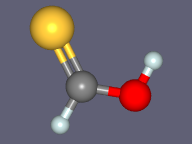
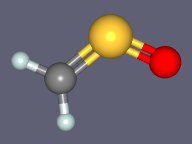
Schreiner et al.). Structures of t-HC(S)OH, H2CSO,
and HCSOH are shown below.
| 
| 
|
| t-HC(S)OH
| H2CSO
| HCSOH
|
| (thione isomer)
| (hypervalent sulfur)
| (carbene)
|
|