|
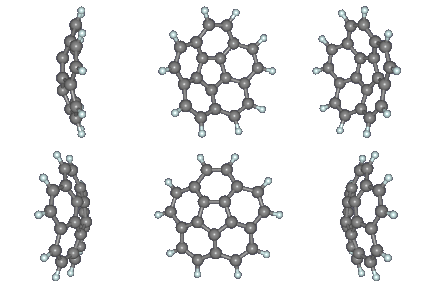
The bowl-shaped, six-ring species corannulene (C20H10) has been the
subject of several unsuccessful searches toward various sources in the last two decades, with two efforts
reported in 2025. First,
Morán and co-workers were not
able to find evidence that corannulene is present toward
TMC-1 in
QUIJOTE
survey data collected with the
IRAM 30m telescope.
Most recently, Koo and co-workers
did not detect the molecule toward the
Red Rectangle nebula based on data collected with
ALMA.
In 2009, Pilleri and co-workers had sought
corannulene in the same source using the IRAM 30m telescope without success. Finally,
Thaddeus and
Klemperer also searched for corannulene
toward TMC-1 and determined it must constitute less than one part in 100,000 of the carbon in the source.
|
|
|
|
Corannulene has several unusual
traits as a
polycyclic aromatic hydrocarbon
containing only carbon and hydrogen: it is aromatic in spite of being non-planar, it has 5-fold symmetry
and falls in the C5v symmetry group, and it has a substantial dipole moment that exceeds 2 D
and is thus comparable to water. It is the last trait that makes corannulene a favorable subject for
detection via its rotational spectrum. Corannulene was first synthesized by
Barth & Lawton in 1966; thay also coined the name
corannulene, which is much preferable to IUPAC name, dibenzo[ghi,mno]fluoranthene.
|