|
The pure carbon molecule C5 was detected toward
IRC +10216 (CW Leo) by
Bernath et al. in 1989 using the
4-meter telescope at
Kitt Peak National Observatory. Since C5 has no dipole moment
and thus no rotational spectrum, it was detected via a particularly intense vibrational mode (see below), which
gives rise to a
ro-vibrational spectrum
that was used to detect the molecule. To date, C5 has only been detected in the one source. It has
been unsuccessfully sought toward ζ Oph by
Maier et al. and toward various translucent clouds by
Galazutdinov et al.
|
|
|
|
No vibrational spectrum was available when Bernath et al. set out to search for C5.
Vala et al. characterized it. A number of
additional experimental studies have followed. For example,
Heath et al. measured the ro-vibrational
spectrum (and published back-to-back with the detection),
Moazzen-Ahmadi et al. characterized the
13C spectroscopy of the intense band, and
Boguslavskiy & Maier measured its
electronic spectrum.
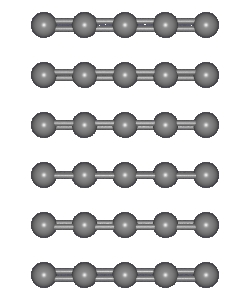
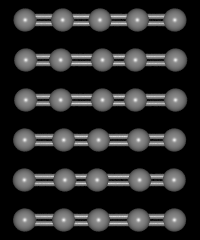
C5 or pentatetraenediylidene or, more precisely,
1,2,3,4-pentatetraene-1,5-diylidene, is related to other known astromolecules, particularly
C3,
C5H, and
C5S. C5 is a classic
carbene.
|